The story as it is told
Once you know that Bram was short for Abraham, the professor's name looks like a signature. Stoker named Abraham Van Helsing after himself. The hunter in the book is the author, given a Dutch surname and a string of degrees.
What we can confirm
Robert Eighteen-Bisang and Elizabeth Miller, in Bram Stoker's Notes for Dracula, write that Bram Stoker and his father were both named Abraham, and that Bram is a diminutive of Abraham. The same edition says Abraham (Bram) Stoker was born in Clontarf, outside Dublin, on 8 November 1847. The working notes they transcribe are the leaves at the Rosenbach Museum and Library in Philadelphia, catalogued there as Dracula: notes and outline, about 1890 to about 1896.
The novel uses the first name in its headings. In the Project Gutenberg text, one section is headed "Letter, Abraham Van Helsing, M. D., D. Ph., D. Lit., etc., etc., to Dr. Seward." A later section is headed "Memorandum by Abraham Van Helsing."
The notes show the character arriving in pieces. An early list, which Eighteen-Bisang and Miller transcribe from the Rosenbach leaves, includes the line "A German Professor ___ Max Windshoeffel," set beside a detective and a psychical research agent. They write that the name Van Helsing appears later, on the character list they number as page 38, and that the professor may combine three figures from the first lists: a philosophic historian, a German professor of history, and a detective. In an annotation on those lists they write that Stoker "bestowed his given name, 'Abraham,' on Professor Van Helsing." An earlier Abraham in the notes, the solicitor Abraham Aaronson, was revised into the lawyer Peter Hawkins. An outline still calls the man at Lucy's deathbed the "German Professor." Their note on that line is that the Dutchman, Abraham Van Helsing, was originally of German origin in the drafts.
The same editors record that, soon after the novel was published, Stoker told an interviewer the professor "is based on a real character." They trace the first name to Stoker. For a living model they name two candidates in the notes and in his life: the Oxford professor Max Muller, and Stoker's brother William Thornley.
An early aide-memoire in the same notes tries another name for the villain, Count Wampyr. That naming is in Dracula Was Almost Called Count Wampyr.
The part has been played on screen more than once. The Washington Times of 14 February 1931, reviewing the film Dracula, describes Edward Van Sloan stepping out of his character of Dr. Van Helsing. In 2004, a New York Times review of Van Helsing says Hugh Jackman plays a reinterpreted Professor Abraham Van Helsing, a swashbuckling hero in place of the academic of the novel.
The 1922 film Nosferatu, and Florence Stoker's suit over it, renamed Stoker's people and then went to court. Those stories are in Bram Stoker's Widow Won and Florence Stoker vs. Nosferatu.
The facts
- Bram and his father were both named Abraham. Bram is a diminutive of Abraham. Abraham Stoker was born in Clontarf on 8 November 1847. Robert Eighteen-Bisang and Elizabeth Miller, Bram Stoker's Notes for Dracula: A Facsimile Edition (Jefferson, N.C.: McFarland, 2008), mcfarlandbooks.com
- The notes are at the Rosenbach Museum and Library, Dracula: notes and outline, about 1890 to about 1896. rosenbach.kohacatalog.com
- Early list in the notes: "A German Professor ___ Max Windshoeffel," with a detective and a psychical research agent. The name Van Helsing appears on the later list the editors number as page 38. They write that Stoker "bestowed his given name, 'Abraham,' on Professor Van Helsing," and that Abraham Aaronson became Peter Hawkins. Eighteen-Bisang and Miller, same book.
- An outline still says "German Professor" at Lucy's death. The editors' note: the Dutch Abraham Van Helsing was originally of German origin in the drafts. Same book.
- Stoker told an interviewer the professor "is based on a real character," as recorded by Eighteen-Bisang and Miller from Jane Stoddard. Same book.
- Headings in the novel: "Letter, Abraham Van Helsing, M. D., D. Ph., D. Lit., etc., etc., to Dr. Seward" and "Memorandum by Abraham Van Helsing." Project Gutenberg #345, gutenberg.org
- Edward Van Sloan as Dr. Van Helsing in the 1931 film. Washington Times, 14 February 1931, p. 7, loc.gov
- Hugh Jackman in Van Helsing (2004), a reinterpreted Professor Abraham Van Helsing. New York Times, 19 October 2004, nytimes.com
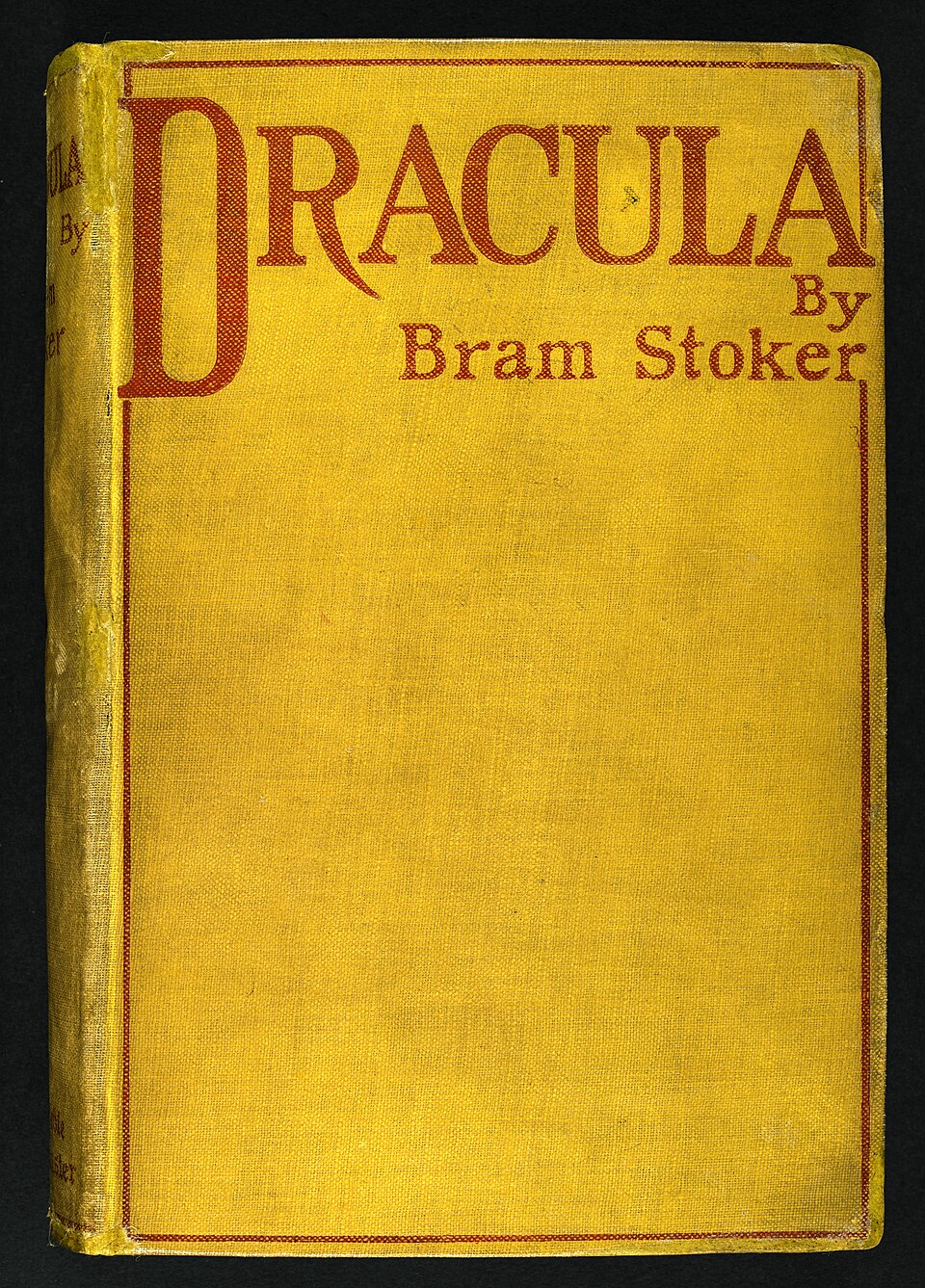
- First edition, 1897, Westminster, Archibald Constable and Company. Yellow cloth, red lettering. British Library, usage terms public domain, web.archive.org
- Cloth cover scan. Wikimedia Commons, public-domain scan of the 1897 cover, commons.wikimedia.org
Sources
- Robert Eighteen-Bisang and Elizabeth Miller, eds., Bram Stoker's Notes for Dracula: A Facsimile Edition (Jefferson, N.C.: McFarland, 2008): mcfarlandbooks.com
- Rosenbach Museum and Library catalog, Bram Stoker, Dracula: notes and outline, about 1890 to about 1896: rosenbach.kohacatalog.com
- Bram Stoker, Dracula, Project Gutenberg #345: gutenberg.org
- Washington Times, 14 February 1931, p. 7: loc.gov
- New York Times, "Van Helsing" (DVD review), 19 October 2004: nytimes.com
- British Library, "First edition of Dracula" (saved page; usage terms: public domain): web.archive.org
- Wikimedia Commons, first-edition cloth cover, 1897: commons.wikimedia.org
Related: Is Nosferatu public domain? · Is Dracula (1931) public domain? · What enters the public domain in 2027