The story as it is told
Florence Stoker found out that a German company had filmed her husband's novel without asking. She spent years trying to wipe Nosferatu off the screen. She won. A court told the company to destroy every print, and that was supposed to be the end of Count Orlok.
What we can confirm
Florence Anne Lemon Balcombe married Bram Stoker on 4 December 1878, at St Ann's Church on Dawson Street in Dublin. Bram died in 1912. She was his literary executor. The Bram Stoker Estate says that after his death she managed the publication and adaptation of his work. At the time of the film she was living in straitened circumstances in Knightsbridge. Most of his books were out of print, and Dracula brought in few royalties.
EBSCO dates the gala opening of Nosferatu: Eine Symphonie des Grauens to Saturday, 4 March 1922, at the Marble Hall of the Berlin Zoological Gardens. The Irish Times dates the Berlin premiere to 5 March 1922. It was the first production of Prana-Film. Albin Grau was a codirector of the company, Henrik Galeen wrote the script, and F. W. Murnau directed. The credits said the film was based on Dracula. Prana-Film had not negotiated the rights with Stoker's estate.
Galeen changed the names and moved the story from England to Germany. Count Dracula became Graf Orlok. Jonathan Harker became Thomas Hutter, Mina Harker became Ellen Hutter, and Professor Abraham Van Helsing became Professor Bulwer. Stoker's working notes had used another name years earlier. English Heritage says that in 1890, before a Whitby library footnote supplied "Dracula," the villain in his draft was Count Wampyr. That name belongs to the drafts of the novel. It is not a name this film's script used. See Dracula Was Almost Called Count Wampyr.
She learned of the film the month after the premiere, when an anonymous correspondent mailed her the program. She joined the British Incorporated Society of Authors. Its secretary, G. Herbert Thring, took the matter to the committee, which hired the Berlin lawyer Manfred Wronker-Flatow. She eventually mailed as many as half a dozen letters a month to the society.
By the middle of 1922 Prana-Film had gone bankrupt and was in receivership. Nosferatu was its only film. Contemporary press reports said the company spent more money publicizing the film than producing it. The receivers, the Deutsch-Amerikanische Film-Union, offered her a share of the profits if she let them show the film in the English-speaking world under the title Dracula. On the society's advice, she refused.
A hearing was held in Berlin in late March 1924, and the case began in May. Two months later the court ruled for her. She offered to sell the receivers the rights to the novel for £5,000. They appealed instead. They lost that appeal early the next year, and in July 1925 they were ordered to destroy the negative and all the prints. The company was bankrupt, so there were no damages to collect. A shorter account of the lawsuit is Bram Stoker's Widow Won.
The Irish Times, writing in 2022, says no damages appear to have been paid, and that so many prints had already gone out that a case in every country was not practical. Dacre Stoker, Bram's great-grandnephew, told the paper that letters from the society's lawyers suggest the lawyers were the ones who said the prints should be destroyed. He rejected the claim that the idea was Florence's.
The order did not catch every copy. As early as 1922 she knew of showings in Budapest and Paris. In October 1925 the new London Film Society announced a Sunday afternoon screening, billed as Dracula. That screening was canceled. In January 1926 Thring wrote that the society was withdrawing from the case. On 16 December 1928 the Film Society showed the film at the New Gallery Kinema in London. She could not stop that screening. EBSCO says the print used for it was apparently burned in 1929. Two months later the film had its American premiere at the Film Guild Cinema in Greenwich Village. An H-Net review of the film, citing David J. Skal, says copies survived in France and the United States. NPR reports that surviving prints reached film archives and museums in Germany, France and New York.
While the German case was still open, she licensed a stage play. The Bram Stoker Estate says Hamilton Deane's adaptation was first performed at the Grand Theatre in Derby on 15 May 1924. The Guardian calls it the first authorized stage version and says the first difficulty was getting Florence to agree, because she was already fighting over Nosferatu. The same article says she received no money from the film's company, which was bankrupt. The Irish Times reports that Universal later bought the screen rights for $40,000. The Guardian reports that Universal bought the rights to the Deane and Balderston play, the version behind the studio's 1931 film. For that film's own status, see Is Dracula (1931) public domain?.
Nosferatu is in the public domain in the United States. Cornell's chart places works first published outside the United States before 1931 in the public domain in the United States, and this film opened in Berlin in 1922. Later restorations, new scores and remakes are separate works. See Is Nosferatu public domain?.
The facts
- Married Bram Stoker on 4 December 1878 at St Ann's Church, Dawson Street, Dublin. Literary executor after his death in 1912. The estate says she then managed publication and adaptation of his work. Bram Stoker Estate, bramstokerestate.com
- Living in straitened circumstances in Knightsbridge; few royalties; program mailed the month after the premiere; joined the Society of Authors; Prana-Film bankrupt by midyear; only film; July 1925 order to destroy the negative and all prints; American premiere at the Film Guild Cinema. EBSCO Research Starters, ebsco.com
- Name changes: Count Dracula to Count Orlok, Jonathan Harker to Thomas Hutter, Mina Harker to Ellen Hutter, Van Helsing to Professor Bulwer. Copies survived in France and the United States. H-Net Reviews, h-net.org
- British Incorporated Society of Authors; no damages paid; Universal bought the screen rights for $40,000. The Irish Times, irishtimes.com
- Deane's play, Derby, May 1924; Florence's agreement; no money from the bankrupt film company; Universal bought the Deane and Balderston play. The Guardian, theguardian.com
- Draft villain Count Wampyr, Whitby, 1890, before the name Dracula. English Heritage, english-heritage.org.uk
- Surviving prints in archives in Germany, France and New York. NPR, npr.org
- Works first published outside the United States before 1931 are in the public domain in the United States. Cornell University Library, copyright.cornell.edu
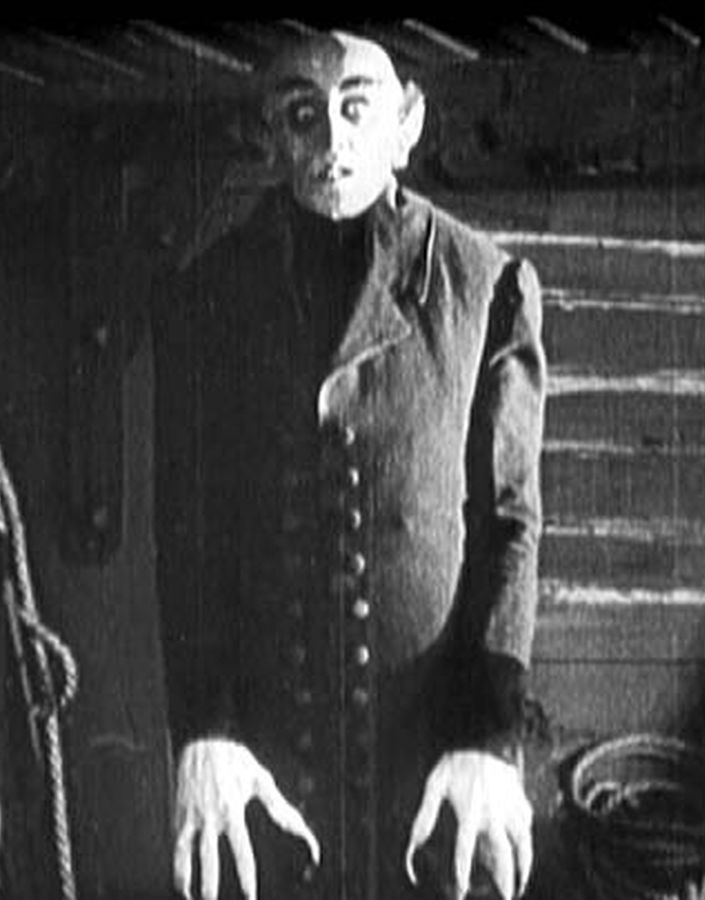
- Still of Max Schreck as Count Orlok, from the 1922 film. Wikimedia Commons marks the file public domain. commons.wikimedia.org
Sources
- EBSCO Research Starters, "Nosferatu Is Found to Have Violated Dracula Copyright" (Grove Koger, 2022): ebsco.com
- The Irish Times, "Nosferatu and the fangs of copyright infringement" (Derek Scally, 5 March 2022): irishtimes.com
- The Guardian, "Fangs for the memories: how Dracula was made in Derby" (Caroline Butterwick, 3 June 2024): theguardian.com
- Bram Stoker Estate, "Florence Stoker": bramstokerestate.com
- English Heritage, "How Dracula Came to Whitby": english-heritage.org.uk
- Amanda Hobson, review of Nosferatu, H-Net Reviews (H-German, October 2009): h-net.org
- NPR, "Try as she might, Bram Stoker's widow couldn't kill 'Nosferatu'" (15 March 2022): npr.org
- Cornell University Library, "Copyright Term and the Public Domain in the United States": copyright.cornell.edu
- Wikimedia Commons, still of Max Schreck as Count Orlok: commons.wikimedia.org
Related: Is Nosferatu public domain? · Is Dracula (1931) public domain? · What enters the public domain in 2027