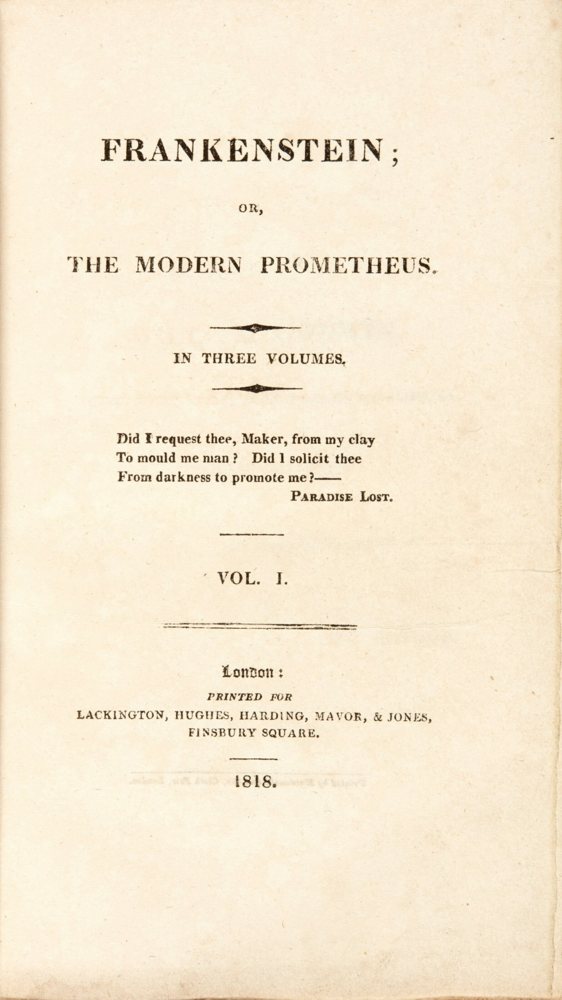
Frankenstein came out on 1 January 1818 in three volumes, 500 copies, with no author’s name on the title page.
In March, Walter Scott reviewed it in Blackwood’s Edinburgh Magazine, and he loved it: an “extraordinary tale, in which the author seems to us to disclose uncommon powers of poetic imagination.” Then he passed along the gossip: “it is said to be written by Mr Percy Bysshe Shelley.”
Mary set him straight. On 14 June 1818 she wrote that she was “anxious to prevent your continuing in the mistake of supposing Mr. Shelley guilty of a juvenile attempt of mine,” and explained that she had kept her name off the book because she had written it so young.
Other readers guessed better, or worse. A friend of Percy’s, Thomas Jefferson Hogg, drafted a letter telling one reader that if he added “Percy Bysshe” to the name Shelley, “the infirmity of our nature interposes between you & the truth wch whispers Mary.” The British Critic heard the author was “a female” and called that “an aggravation.”
Her name finally reached the title page in August 1823. A stage hit, Presumption; or, The Fate of Frankenstein, had prompted her father, William Godwin, to order a new edition, and this one named the author: Mary Wollstonecraft Shelley.
Related: Is Frankenstein (1931) public domain? · What enters the public domain in 2027