The story as it is told
Two months after A Christmas Carol came out, a cheap paper stole it. Dickens sued. The court sided with him, the pirates declared bankruptcy, and the bill landed on Dickens. Later writers put that bill at about £700, more than he had cleared on the first printing.
What we can confirm
The dates and the parties come from the Chancery papers as the solicitor E. T. Jaques printed them in 1914, and from John Forster's Life of Charles Dickens, which quotes Dickens's letters.
Dickens's affidavit, in Jaques, says the book was published on 19 December 1843. On 6 January 1844 the defendants had already printed part of a work "entitled A Christmas Ghost Story, reoriginated from the original by Charles Dickens, Esquire, and analytically condensed expressly for this work," as number 16 of Parley's Illuminated Library. That number, the affidavit says, was a colourable imitation of about half the book. One change of name was Fezziwig to Fuzziwig. Henry Hewitt did the condensing. An affidavit for the defense, also in Jaques, says the Ghost Story sold at a penny and the Carol at five shillings. Mark Rose, writing in the Cardozo Arts and Entertainment Law Journal in 2023, adds that a second and final installment was to follow on 13 January.
Dickens's solicitor was Thomas Mitton. On 10 January 1844, the day after the bill was filed, counsel asked Vice-Chancellor Sir James Knight Bruce for an interim injunction. It was granted against Richard Egan Lee and John Haddock, booksellers and publishers of Craven Yard, Drury Lane. Dickens filed four more bills, against the booksellers George Berger, John Cleave, William Strange and William Mark Clark. Jaques writes that none of those four showed fight. The case that did is Dickens v. Lee. Rose cites the report of the hearings of 18 and 25 January 1844 in The Jurist 8.1, Dickens v. Lee (1844) 8 Jurist 183, and the Times reports that Jaques reprints.
Lee and Haddock moved to dissolve the injunction. On 18 January Knight Bruce refused. Dickens wrote to Forster the same day, after leaving court: "The pirates are beaten flat. They are bruised, bloody, battered, smashed, squelched, and utterly undone." A further hearing followed on 25 January. Forster writes that the compromise was an ample public apology and payment of Dickens's costs, "but the real result was that, after infinite vexation and trouble, he had himself to pay all the costs incurred on his own behalf."
Years later, when another piracy came up, Dickens wrote to Forster from Switzerland: "I shall not easily forget the expense, and anxiety, and horrible injustice of the Carol case, wherein, in asserting the plainest right on earth, I was really treated as if I were the robber instead of the robbed."
The sum is where the accounts part. Philip V. Allingham, on the Victorian Web, writes that Dickens's income on the first 6,000 copies was £230, and that the costs of suing "Peter Parley's Illuminated Library" came to £700 "when the malefactors declared bankruptcy." Rose also writes that Lee and Haddock declared bankruptcy and that Dickens was left with significant court costs, and he cites Jaques for that sentence. Jaques, who read the papers, does not use the word bankruptcy. He writes that the costs of the five suits "must have been serious: probably at least as many hundred-pounds." The only figure of seven hundred pounds in his book is a Times estimate, dated 18 January 1844, for the expense of a different bill and answer. Forster names no sum. Later accounts say about £700. The solicitor who read the file would only say some hundreds of pounds.
How the book came to be written, and the pamphlet Dickens set aside, is in The Pamphlet Dickens Never Wrote.
The story is retold often. The New York Times review of Spirited (2022), directed by Sean Anders, calls that Apple film another adaptation of A Christmas Carol.
The facts
- Published 19 December 1843. On 6 January 1844, number 16 of Parley's Illuminated Library carried part of "A Christmas Ghost Story," described as reoriginated from Dickens and analytically condensed, a colourable imitation of about half the book, with Fezziwig changed to Fuzziwig. Jaques's print of Dickens's affidavit, archive.org
- The Ghost Story sold at a penny and the Carol at five shillings. Defense affidavit in Jaques, same book.
- Interim injunction, 10 January 1844, Vice-Chancellor Sir James Knight Bruce, against Richard Egan Lee and John Haddock. Four other bills, against Berger, Cleave, Strange and Clark, were not fought. Jaques.
- Hearings of 18 and 25 January 1844. Dickens to Forster, 18 January: "The pirates are beaten flat." Forster: Dickens paid his own costs. John Forster, The Life of Charles Dickens, gutenberg.org
- Later letter to Forster: "I shall not easily forget the expense, and anxiety, and horrible injustice of the Carol case." Forster, same book.
- Later accounts: £230 on the first 6,000 copies, and £700 in costs when the defendants declared bankruptcy. Philip V. Allingham, Victorian Web, victorianweb.org
- Rose (2023): second installment due 13 January; Lee and Haddock declared bankruptcy; significant court costs, citing Jaques. Report: Dickens v. Lee (1844) 8 Jurist 183. larc.cardozo.yu.edu
- Jaques on the figure: the five suits "must have been serious: probably at least as many hundred-pounds." The seven hundred pounds in his book is a Times estimate for a different bill and answer. Same Internet Archive book.
- Spirited (2022), directed by Sean Anders, an Apple adaptation of A Christmas Carol. New York Times, 10 November 2022, nytimes.com
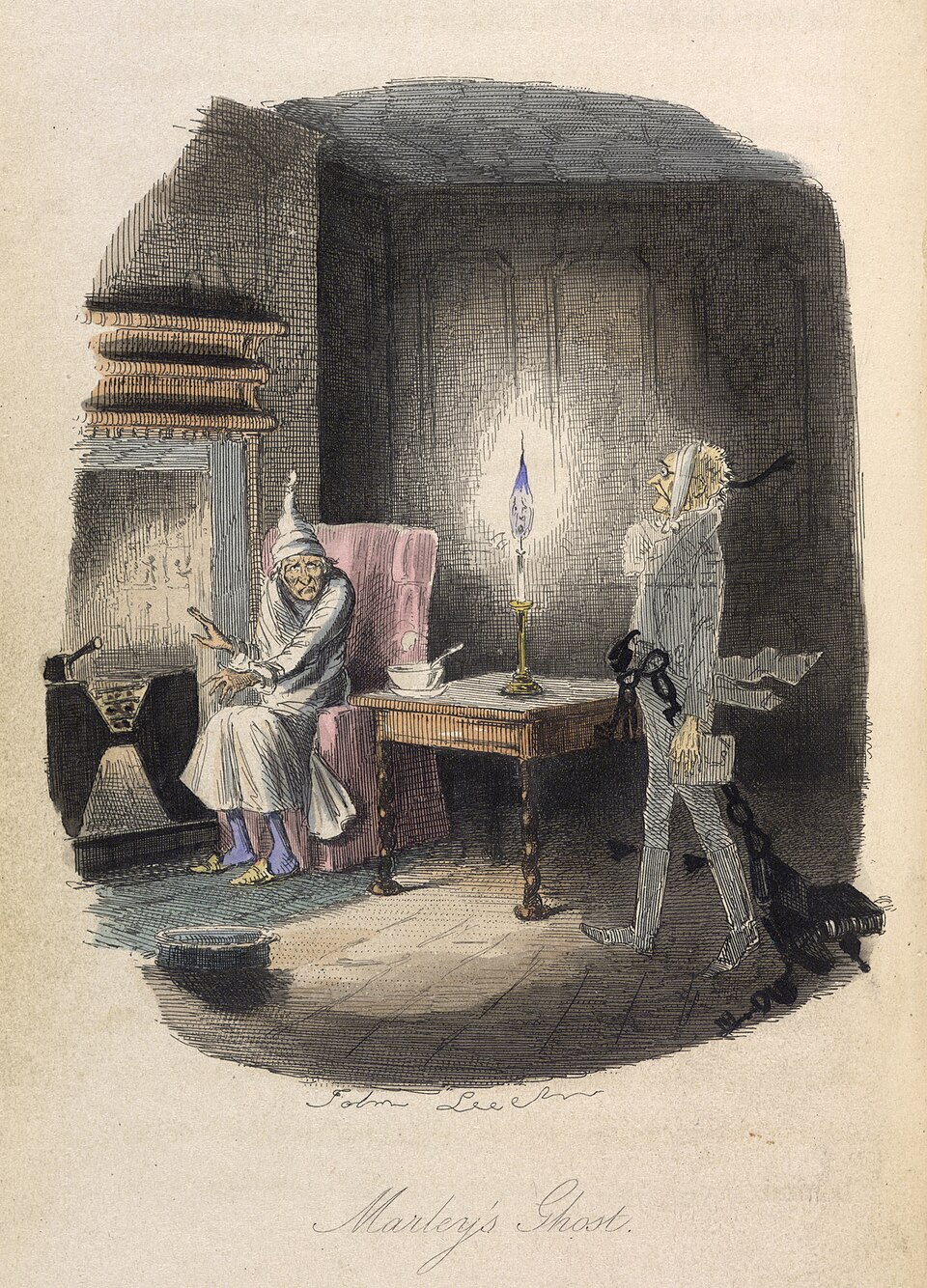
- John Leech, Marley's Ghost, 1843. Wikimedia Commons, public domain, commons.wikimedia.org),_opposite_25_-_BL.jpg
Sources
- E. T. Jaques, Charles Dickens in Chancery (London: Longmans, Green, 1914), Internet Archive: archive.org
- John Forster, The Life of Charles Dickens, Project Gutenberg #25851: gutenberg.org
- Mark Rose, "Dickens v. Lee (1844): A Christmas Tale of Two Experts Testifying," 41 Cardozo Arts & Entertainment Law Journal 227 (2023): larc.cardozo.yu.edu
- Philip V. Allingham, "Charles Dickens's A Christmas Carol (1843): An Introduction," Victorian Web: victorianweb.org
- New York Times, "Spirited review," 10 November 2022: nytimes.com
- Wikimedia Commons, John Leech, Marley's Ghost (1843), British Library copy: commons.wikimedia.org),_opposite_25_-_BL.jpg