Thanksgiving 2026 · A lost holiday. About a 7-minute read. Not legal advice.
The lead
🎭 Thanksgiving's masked beggars
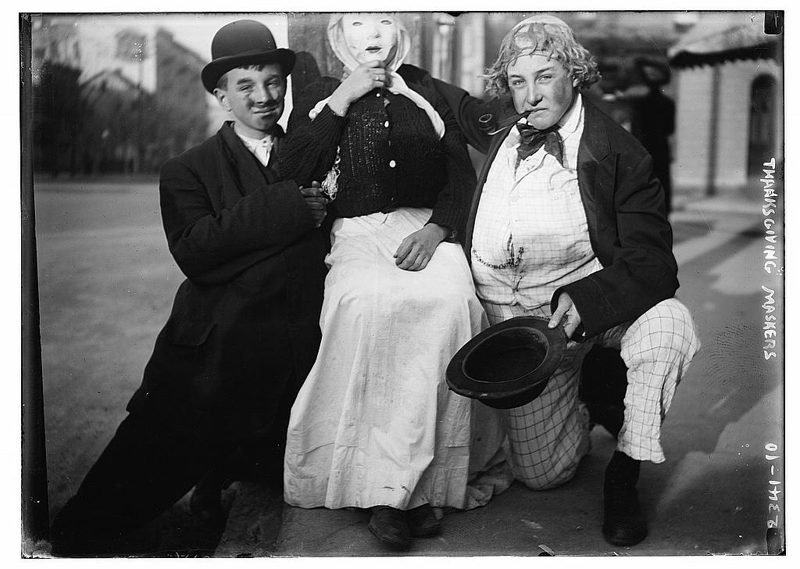
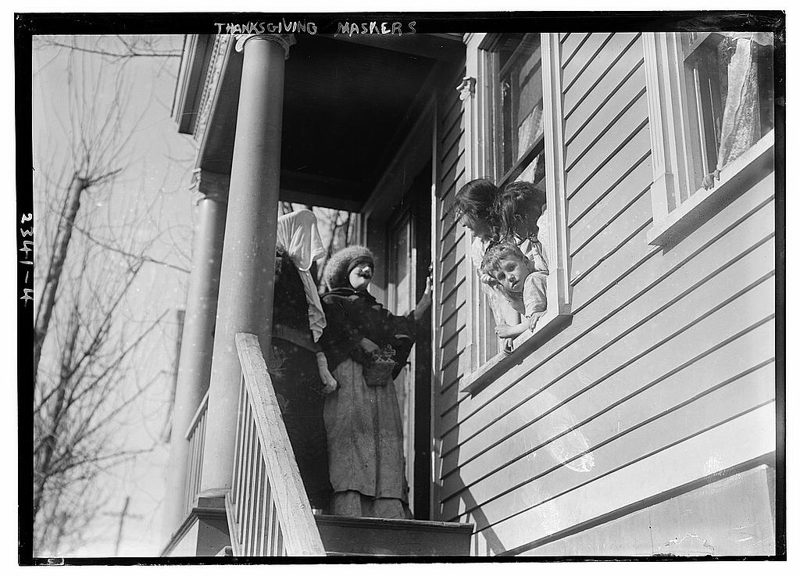
Thanksgiving Maskers, Bain News Service, ca. 1910-15. Library of Congress, Prints & Photographs Division, LC-DIG-ggbain-10008 (no known restrictions)
In November 1930, New York City's schools superintendent, William J. O'Shea, sent a circular to the city's schools. "Modernity," it said, as quoted by the New York Public Library, "is incompatible with the custom of children to masquerade and annoy adults on Thanksgiving day." The New York Times headline that week read "O'Shea Acts to End Parades Of Thanksgiving Ragamuffins."
The day after Thanksgiving, the Times reported the result: "Parading Thanksgiving Ragamuffins Scarce, Except Out Where City's Subway Lines End."
So what was he trying to kill?
Go back to 1909. On Sunday, November 21, the Rev. Dr. James M. Farrar of the First Reformed Church in Brooklyn gave a children's sermon on "Thanksgiving Ragamuffins," and the New-York Daily Tribune printed it the next morning. "Ragamuffin Day will soon be forty years old," he told the children. "About the year 1870, on Thanksgiving Day, the different societies in New York dressed in elegant costumes, paraded the streets and made social calls. The children, quick to see a chance for fun, began to imitate the grown-ups. Dressing in old clothes, many sizes too large, painting their faces or putting on masks..."
Farrar liked the custom. "The Thanksgiving custom of our juniors is, I believe, here to stay," he said. "In fact I would be sorry to see it given up. If it is here to stay, how can we make it pay?" His answer was to ask the children to put their pennies in the church's Thanksgiving offering for the poor.
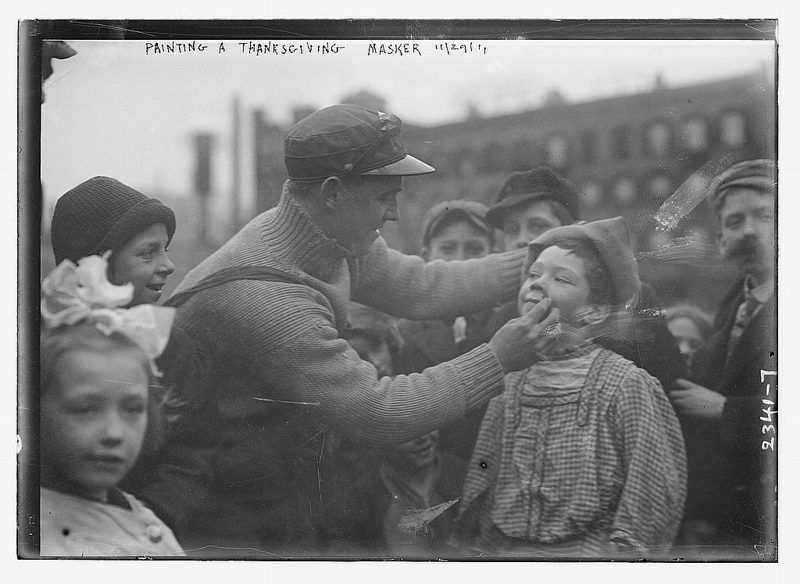
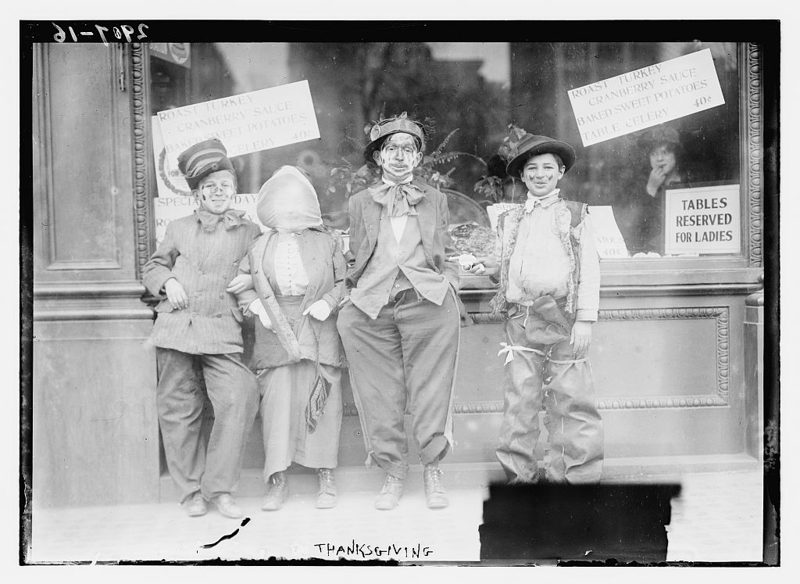
Two years later, the Bain News Service photographed the maskers on New York's streets. The Library of Congress files the glass negatives as Thanksgiving holiday scenes from 1911: children in bowler hats, drawn-on mustaches, wigs and white masks, scrambling for pennies. The question they asked at the door, according to the NYPL's history of the custom, was "Anything for Thanksgiving?"
By 1930 the city's patience had run out, and charities offered a tidier version. Starting in 1937, the Madison Square Boys Club ran a supervised Thanksgiving costume parade. The Times described it in 1938 as "Taking the Place of Ancient Custom," and in 1940 ran the headline "400 BOYS PARADE AS RAGAMUFFINS." That parade's slogan, as quoted by the NYPL, was "American boys do not beg."
The custom faded slowly. The Times still listed "Ragamuffins Parade" in its Thanksgiving coverage on November 23, 1956, the last mention the NYPL found.
So was this the birth of trick-or-treating?
Scholars disagree, and both sides make a fair case.
In 1994 the folklorist Tad Tuleja called New York's Thanksgiving masking "the most plausible 'missing link' between European solicitation customs and trick or treat."
In 2020, Stephen Winick of the Library of Congress's American Folklife Center wrote that Tuleja "makes a convincing argument." His reason is that Thanksgiving masking "we know was widespread in America just before trick-or-treating emerged."
The historian Samira Kawash, writing in the American Journal of Play in 2011, isn't convinced: "if Thanksgiving mummery is the missing link, it is a strange one." She found that trick-or-treating arrived in the East "sometime in the late 1940s," and that the earliest descriptions come from farther west, in Indiana, Washington and Oregon.
Here's what the record does show. Costumed children begged door to door in New York on Thanksgiving by the late 1800s, a pastor dated it to about 1870, and the city spent the 1930s trying to end it. Meanwhile, the NYPL notes, Halloween begging "did not become common until the 1940s and '50s." The two customs overlapped in time. Whether one became the other is still an open question.
✅ Can you use it?
The custom: yes. Nobody owns a tradition.
The Bain photographs: yes. The Library of Congress says "No known restrictions on publication." One warning: many frames in this series show children in blackface or minstrel masks. The frames we've used here don't. Check every frame before you publish one.
The 1909 Tribune sermon: yes. It's public domain, and the scan is free at the Library of Congress.
The 1930 New York Times stories: U.S. works from 1930 entered the public domain on January 1, 2026, so the text is free. The Times stories from 1937 on may still be protected, so quote them briefly and link.
The NYPL, LoC and Kawash write-ups: these are modern and protected. Link and quote briefly.
Why creators care: a lost holiday with a villain (a schools memo), a sweet reversal (a pastor who wanted it kept) and free photographs. It's a short documentary, a picture book or a "lost holiday" video series, ready to go.
This week from the class of 1931
⏳ The countdown: 59 days
Fifty-nine days from today, on January 1, 2027, U.S. works from 1931 enter the public domain. This week's pick from the class of 1931 is Charlie Chaplin's City Lights.
Three years after the talkies arrived, Chaplin spent two years and a reported $1.6 million on a film with no spoken dialogue (it does have his own score and sound effects). The Library of Congress's National Film Registry essay says the scene where the flower girl first offers the Tramp a flower was retaken hundreds of times. Albert Einstein and his wife were Chaplin's guests at the Los Angeles premiere on January 30, 1931.
The film was registered on February 1, 1931 and renewed in 1958, so it runs through December 31, 2026. What becomes free: the 1931 film. What doesn't: the Tramp as he appears in later films like Modern Times (1936), Chaplin estate trademarks, and his likeness for endorsements. Any separately published sheet music needs its own check.
The countdown
59
Days
until midnight, January 1, 2027
For members
🎬 The Director’s Cut: The Casket He Carried Everywhere
One hundred years ago tomorrow, on Thursday, November 4, 1926, about 2,000 people packed the Elks' clubhouse on West 43rd Street in Manhattan for Harry Houdini's funeral. He was buried in the bronze casket from his own "Buried Alive" act, with his head resting on his mother's letters.
This week's Director's Cut piece starts with that funeral and goes back to find out what really killed him. It covers a McGill student's punches, a burst appendix nobody caught in time, the newspapers that took sides the day after he died, and a widow who waited ten years for a coded message: "Rosabelle, believe."
The free issue tells you what you can use. The Director's Cut tells you the true history behind it: the people, the rivalries, and who got the credit and who didn't, from the primary sources.
Join now
Through Dec 31
$2.99/mo or $24/yr
Standard
From Jan 1, 2027
$4.99/mo or $55/yr
Join by December 31, 2026, and you pay $2.99/month or $24/year for as long as you stay subscribed. From January 1, 2027, the standard price for new members is $4.99/month or $55/year.
🎭 Also in The Director’s Cut: The Blank on the Playbill
In August 1823, Mary Godwin (later Mary Shelley) sat in the English Opera House in London watching the first stage play of Frankenstein. The playbill listed the creature as "--------- by Mr. T. Cooke." Her verdict, in a letter to Leigh Hunt: "this nameless mode of naming the unnameable is rather good." Our second Director's Cut piece follows that blank space from 1823 to the 1931 film's credits. Read the opening free.
Members: one week left for the Diodati Dare
Byron gave his guests one challenge in 1816: "We will each write a ghost story." Our Diodati Dare closes Tuesday, November 10, at 11:59 p.m. PT. Write a ghost story inspired by the real summer of 1816, up to 2,000 words (or a script or comic script up to 8 pages). The best entries will be featured, with credit, in a later issue of The Director's Cut. Read the prompts and rules (members sign in).
Free right now
🦃 Thanksgiving in the archives
Free to use, with no known restrictions. Each link goes to the archive's record page (your receipt).
Thanksgiving Maskers, Bain News Service, ca. 1910-15 (LoC, LC-DIG-ggbain-10008)
Lydia Maria Child, Flowers for Children, Part II (1845), the book with "Over the river, and through the wood" (LoC). Our story on it: Over the River was never a Christmas song.
The Library of Congress lists the Bain photographs as "No known restrictions on publication" (Bain rights statement). Credit line: "Library of Congress, Prints & Photographs Division, LC-DIG-ggbain-#####."
Recommended watching and listening
📬 From Our Friends
A reading and a podcast we recommend this week.
On YouTube
Eldechii reads The Tell-Tale Heart
Eldechii, Keeper of the Lost Ones, reads Poe aloud.
Poe wrote "The Tell-Tale Heart" to be heard, and Eldechii, Keeper of the Lost Ones, gives it the full treatment: the narrator who swears he isn't mad, the old man's eye, and that heartbeat under the floorboards. Turn the lights down and listen.
Mythology, folklore and legends, with the sources named.
Grey Tales is folklore, myths and legends, told by Cris, who names the researchers, editions and dates behind every episode and tells you when a good story isn't true. Start with the Grimm series: part 4 asks whether Hansel and Gretel were murderers, following a satire that half of Germany believed.
More of the 1931 class, one pick a week: Pluto, The Good Earth, M (U.S.-only!), "As Time Goes By" (the song; 1931 recordings wait until 2032). Plus the woman who wrote "Mary Had a Little Lamb" and talked Lincoln into Thanksgiving, and the Phantom of the Opera, who has been free longer than you'd think.
Know someone who'd like this? Forward it along, or send them to commonscut.com to subscribe free. Have a story about where an old story came from? Pitch us at contribute@commonscut.com. A new issue arrives every Tuesday at 6am PT.
Commons Cut is published by Half-In Media LLC (Costa Mesa, CA). This is general information, not legal advice. Public-domain status can depend on publication and renewal facts and differs by country. Talk to a lawyer before commercial use. Found an error? Reply and we'll correct it publicly.