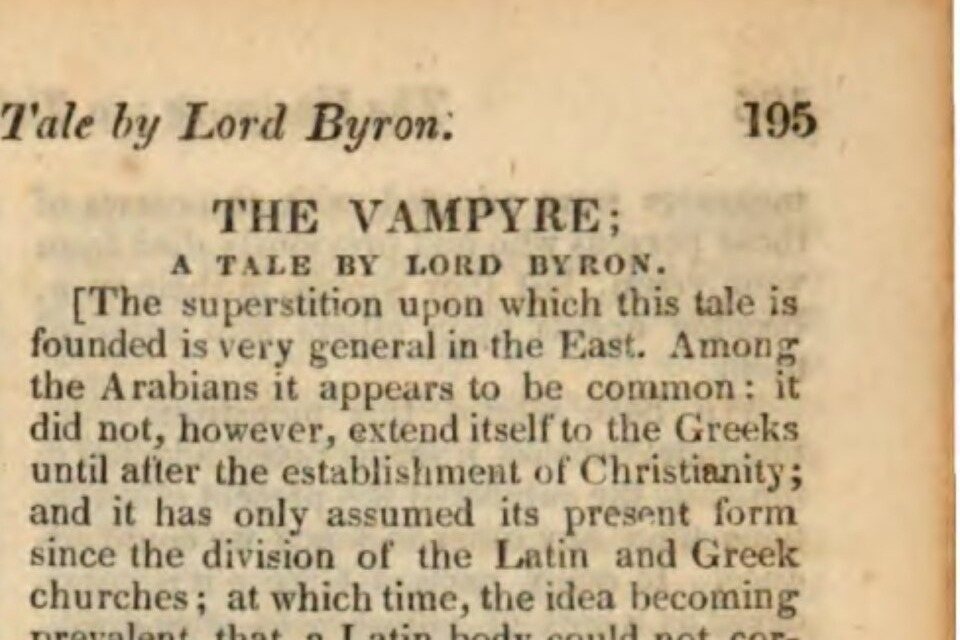
On 1 April 1819, the New Monthly Magazine ran a story under a headline built to sell: “The Vampyre; A Tale by Lord Byron.”
Byron hadn’t written it. The author was John William Polidori, the young doctor who had been with Byron at the Villa Diodati in the summer of 1816, the summer of the ghost-story challenge that also produced Frankenstein.
Polidori wrote to the editor to set it straight: “though the ground-work is certainly Lord Byron’s, its developement is mine.” Byron disowned the tale too. The same issue even named “Miss M. W. Godwin” among the Geneva party and footnoted that her story had already appeared as Frankenstein.
The tale gave English fiction Lord Ruthven, a cold, charming nobleman who moves through society and feeds on it. The aristocratic vampire was on the page 78 years before Dracula.
So how did a doctor’s story end up in print under a lord’s name? Who sent it to London, who got paid, and who has been written out of the famous version of that summer? That’s the story behind The Director’s Cut, No. 1: The Dare at Villa Diodati.
Sources
Related: Is Dracula (1931) public domain? · Is Frankenstein (1931) public domain? · What enters the public domain in 2027